Boling Papers Released
Schwan and Boling held editorial meetings at the ANA Summer Seminar. The highlight of the meetings was the chance for Schwan to review over 100 files that Boling has accumulated for inclusion in Remembered 2. Boling used many of the files in class during week two of the Seminar. Schwan then reviewed more of them during the late night editorial meetings. This transfer is an exciting publishing opportunity according to Schwan. The files will be used for Remembered 2 AND for publication in the Gram. The Gram publication will allow input from readers before the inclusion in Remembered.
The first installment of The Boling Papers appears below. It is the body of two 1947 stories from the New York Times about the Russian printing of Allied military marks. Of course this is a situation that is well known to Gram readers. The importance of the articles is the opportunity to move back in time by reading these 1947 reports.
The Boling Reports 1: The case of the Russian plates
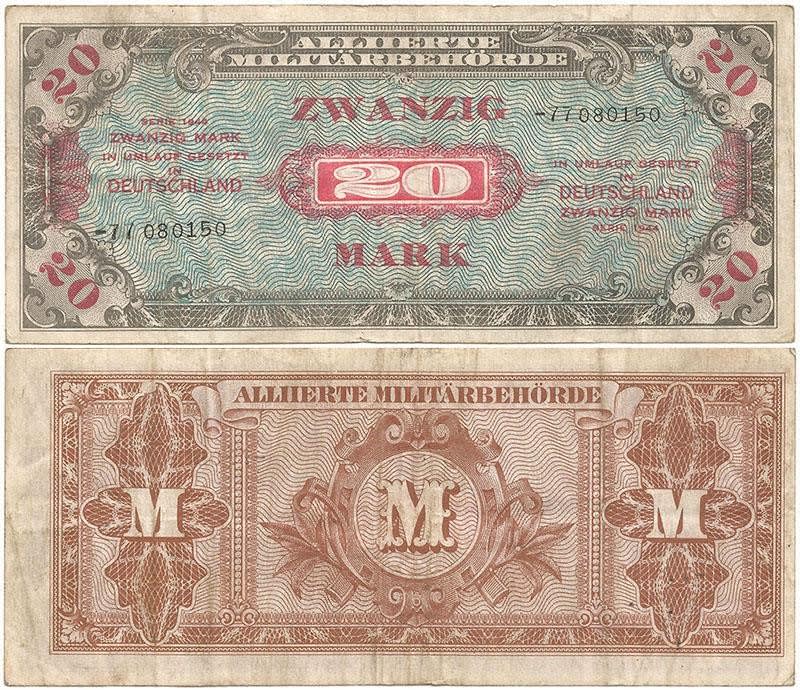
Soviet printed AM mark (eBay image).
RUSSIAN PRINTING OF MARKS GOES ON
Plates were given by the U.S. in 1944 as the price of economic unity. Senators hear.
By ANTHONY LEVIERO
Special to The New York Times. WASHINGTON, June 17 [1947]
Published: June 18, 1947, The New York Times
The Army redeemed $380,000,000 of Allied Military Currency in excess of appropriated funds, and most of it was printed by Russia from American plates, an extraordinary Senate inquiry disclosed today.
Russia, it was shown, is still pouring out the military marks from plates supplied by this country in April 1944, with British assent, as the price of her cooperation toward an unrealized goal, an economically unified Germany. The Army has stopped cashing them for dollars, however. No restrictions were placed on the number of Marks Russia was to print, and a triple-headed Senate committee that began the investigation today will look into this phase tomorrow.
The Appropriations, Armed Services, and Banking and Currency Committees combined in the effort to get to the bottom of the situation. The amazement of several Senators over the disclosures was matched by their recriminations on moral and economic grounds over the means selected by the War Department for liquidating its "long" holdings of Marks.
Petersen Tells Story
The story today came chiefly from Howard C. Petersen, Assistant Secretary of War, and Maj. Gen. George J. Richards, War Department budget officer, with some contributions from a few other generals. The $150,000,000 that German war prisoners earned as wages in this country, the dollars collected by the United Jewish Appeal for displaced persons, and the remittances to businessmen and missionaries in Germany were all being converted into the military marks in the liquidation process, Mr. Petersen said.
Mr. Petersen, who was not yet in office when most of the decisions and incidents in the situation occurred, defended the liquidation procedure, saying the marks were the only legal tender in Germany. He did not agree with several Senators who viewed Russia's uncontrolled possession of the currency plate as a ruinous economic weapon.
The liquidation process was viewed by Senator Wayne Morse, Republican, of Oregon, as a vicious circle in conflict with the Administration's aim of raising the German economy to the self-sufficiency level so that American taxpayers would not have to continue footing the German food bill.
In Germany, he said, he had noted that farmers withheld produce from the market because they had no faith in the currency. The war prisoners had earned $150,000,000, a large foreign-exchange item, but instead they would bring home military Marks that are going to be depreciated. The prisoners' wages, Senator Morse added, were paid by American industry and farmers in American money. His opinion was that this is a very interesting type of tax in this country and Government confiscation to take care of the German Mark problem.
Do the Russians redeem the occupation currency in rubles? Senator Bridges asked.
They do not, not even for their own soldiers, Mr. Petersen replied. He placed the whole problem against this 1944 background:
With respect to Germany, the United States and British Governments desired the Soviet Government to use the same Allied military German currency as that used by the combined U.S.-U.K. military authorities as part of the plan to treat Germany as an economic whole. To agree to the Russians' using a different currency would have constituted an agreement in advance to what actually happened, the division of Germany into four airtight compartments. As you know, this result was never intended and its consequences, which have so gravely hurt our occupation in Germany, were a result assiduously to be avoided.
Negotiations were undertaken with the Soviet authorities in Washington for the purpose of assuring that the Soviet forces would use the same Mark currency. The Soviet authorities agreed to use a German Mark currency of the same design as that which would be used by the United States and British forces in Germany.
Demanded Separate Facilities
However, the Soviets refused the offer of the U.S.-U.K. authorities to furnish the Soviets with adequate supplies of Allied Military Mark currency and demanded that facilities be made available to them from which they could prepare their own supplies of Allied Military Marks.
Negotiations extended over several months. On April 8, 1944, the Russian Government sent a note to the United States stating that, if the plates were not delivered to the Russians, the Soviet Government would be compelled to prepare independently Military Marks for Germany of its own pattern."
The British Government advised this Government that the use of a Russian-produced Mark currency distinct from that used by the United States and the British would be prejudicial, and they agreed (the British did) that the Russians should be given the plates from which the currency was printed.
After due consideration, the United States Government agreed to make the plates available to the Russians, and this was done. On April 18, 1944, the Soviet Ambassador was furnished with glass negatives and positives of plates for the use of the Soviet Government in the printing of Allied Military Marks, together with technical information on inks, paper, and other elements of the printing procedure.
Total Printed Not Disclosed
The hearing did not disclose how many Marks this country had printed. A War Department official said tonight, however, that the equivalent of more than $450,000,000 had been printed, but a lesser amount had been issued. Thus, the Marks redeemed for troops over and above appropriated Army funds almost equaled the amount issued.
None of the occupying powers is obliged to redeem the occupation money, which is issued under the laws of war. When a peace treaty is signed, Mr. Petersen explained, Germany could be compelled to redeem any unliquidated quantity.
Earlier, Mr. Petersen had said of the $380,000,000 that methods of liquidation had been decided on for the liquidation of all but $160,000,000, but that it was expected that this remainder would be disposed of in eighteen months.
Of the total sum, $250,000,000 was in the Marks and $75,000,000 in Yen acquired in Japan.
SENATORS ASK PLAN ON GERMAN MONEY
Investigators Seek Currency Program From War, State, and Treasury Chiefs
By ANTHONY LEVIERO
Special to The New York Times. WASHINGTON, June 19 [1947]
Published: June 19, 1947, Copyright © The New York Times
The Senate Appropriations, Armed Services, and Banking and Currency Committees decided in combined sessions today to request the Secretaries of State, War, and the Treasury to submit recommendations for currency reform in Germany.
The combined group also announced that Henry Morgenthau Jr., former Secretary of the Treasury, might be summoned to explain why Russia received American plates for the unrestricted printing of Allied Military Marks. The inquiry has revealed that the Army redeemed $250,000,000 of the invasion money in excess of its appropriated funds. This was part of a total excess of $380,000,000, excluding $75,000,000 in Yen and other foreign currencies, which the Army is now endeavoring to liquidate by various means.
The surplus marks were attributed to Russian origin from the American plates.
Says Roosevelt Was Consulted
The investigators were told today by John J. McCloy, former assistant Secretary of War and now president of the International Bank for Reconstruction and Development, that he was "under the impression" that the late President Roosevelt had been consulted before the plates were turned over to Russia. He added his belief that either Mr. Morgenthau or Cordell Hull, the then Secretary of State, had seen Mr. Roosevelt.
Mr. McCloy, like Maj. Gen. John H. Hilldring, assistant Secretary of State for Occupied Areas, defended the transfer of the plates to Russia in April 1944. General Hilldring, then chief of the War Department's Civil Affairs Division, said the matter had to be considered in the atmosphere of the time. The American invasion of the Continent had not begun, but the Russians had broken into eastern Poland and Odessa had been captured. The Russians made a very plausible and reasonable case that their currency control should not be delegated to another power, he said. They felt that their armies should not risk running out of invasion money, he continued, and anyway this country did not want to have two Germanys in one of which Russia would print her own currency.
Backed By McCloy
If the plates had been refused, General Hilldring declared, the decision that Russia could not be a partner in Germany would have been made by the United States. Mr. McCloy agreed as he was leaving the stand. General Hilldring recalled that the Russians had said they had stopped using the American plates.
The Soviets did notify the Allied Control Council in Berlin he said, that they had ceased to issue Allied Military Marks on July 1, 1946. I cannot say that none has been issued since.
A. W. Hall, director of the Bureau of Engraving and Printing, testified that the printing of the Marks had cost $844,429.52. Britain bore half the cost, but Russia was not asked to pay the $60,000 cost of the plates furnished to her.
Editorial
It was great fun going through what we are now calling The Boling Papers. They (the papers) are inspiring me to work more on Remembered 2. To me he most interesting and potentially important thing in Papers 1 was the comment that the money earned by POWs in the United States would be paid in Allied military marks. At first that was a surprise to me, but in thinking it over, we might have numismatic evidence of this plan.
Jim Downey in the recently release Pay to the Order of Victory points out that what we routinely have called POW checks were actually payment orders. these payment orders were to be cashed in the home country. In the case of Germans which was most of the POWs this would effectively have accomplished the payment mentioned in the NYT articles.
In this case we chose to not make any editorial changed to the articles above other than very minor formatting changes necessitated by changes created when the text was moved among and between computer systems. There are a few editorial changes that I would like to make bot did not. Specifically, the 1947 NYT printed "Yen" and "Mark" in uppercase. That is not in keeping with Gram style, but it is interesting to see the 1947 style.
An interesting little tidbit was included. The director of the Bureau of Engraving and Printing reported the total cost of printing the Allied marks at $844,429.52 and the most of providing the materials to the Russians at $60,000. I have never seen these figures. Those amounts will be put into Remembered immediately.
Mail Call
The Gram A welcomes mail from readers. Mail may be edited for space or clarity. Writers must be known to the editorial office and will be identified in the Gram by real or nickname.
Hi Everyone,
I have had request to see what I presented at CSNS this last spring, American Red Cross in World War II. If you want to see it, go to the Newman Numismatic Portal. Select view the recordings and find my presentation.
— Kathy
Dear Kathy,
Thanks for sending this notice. I look forward to seeing the program and to reports from other Gramsters too.
— Editor
Training Schedule (calendar)
2026
In this section, the MPGram lists events that are likely to be of special interest to collectors who are interested in MPC and other type of military numismatic items. We do not list "routine" coin shows where a collector might find a few items by chance. However, if we know that some Festers or Gramsters will be there we will list that same show in the hope of promoting fellowship. Send us your reports.
ANA World's Fair of Money® - 25-29 Aug, Pittsburgh
Please help us fill in the dates for events listed and give us any additional events that might conflict. Thank you very much.
MPCFest sponsors
Joe and Louise Boling, Mike Buckley, Steve Fahrlander, Ray Feller family, Dave Frank, Kathy Freeland, Loretta Freyser, Al Glaser, Dave Hunsicker, Brett Irick, Jennifer and Eric Kibbey (dba Camelot Coins), Harold Kroll, Bill Myers.
MPCFest is possible because of the generous support of its sponsors.
Gram Exchange
Do you have something for sale (or trade)? Are you looking for something for your collection? You can offer items here in the Gram or list specific items that you need.
FOR SALE
Send your text and images (!) to the editor for inclusion in the Gram Exchange. Please send the images in jpeg format with each image in a separate file.
List your items for sale here for FREE
WANTED
Wanted to Buy [WTB] / In Search of [ISO] $10 Series 1934A North Africa silver certificate with the altered blue seal discussed in October 2022 MPCGram by Larry Smulczenski (Saturski #13) and covered in May/June 2008 SPMC article written by Peter Huntoon and Jim Downey. Please contact Andy Conroy (andyqconroy@gmail.com)