Summer Seminar under way
The fifty seventh ANA Summer Seminar began with an enthusiastic opening ceremony on Saturday the 20th. The military class kicked off on Sunday the 21st with MC Boot Camp. Six students were eager to learn. Fred said he wanted them to have fun. Early reports indicate that all had at least some of both.
A first for the class was using the Adne Wilde MPC collection as a training. Adne Wilde was a World War II veteran. He was also a Silver Star recipient and member of the famed 10th Mountain Division. Later in life he was president and executive director of the American Numismatic Association. Later still he attended the first ANA military numismatics class. At that class he displayed Allied military lire that he had used and brought home. Now his MPC collection is the property of the association and was used for the first time in training.
FDR Gold Medal Sells
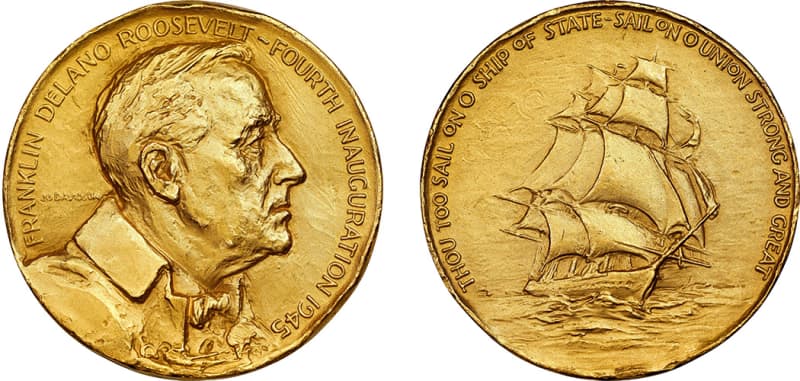
Stacks-Bowers sold the above Franklin Roosevelt inaugural medal for $146,400. The entire lot description is reproduced below with thanks to the auction company.
Incredible Gold Franklin Delano Roosevelt Fourth Inaugural Medal
Unique in Private Hands
Only 10 Struck for Special Distribution to Government Officials and World Leaders
The Specimen Presented to King Ibn Saud of Saudi Arabia
1945 Franklin Delano Roosevelt Official Fourth Inaugural Medal. Dusterberg-OIM 11G45, MacNeil-FDR 1945-1, Levine-FDR 1945-1. Gold. Unc Details-Damaged (NGC).
45.0 mm. 95.3 grams, 1,470 grains, .999 fine, 3.06 troy ounces AGW. In the presidential election of November 7, 1944, Democrat Franklin Delano Roosevelt was elected to an unprecedented fourth term in a strong victory over Republican candidate Thomas E. Dewey. Out of 531 votes in the Electoral College, the president secured 432 votes against Dewey's 99. Roosevelt carried 36 out of the 48 states in the Union, and received 25,612,916 popular votes as opposed to 22,017,929 for Dewey. With World War II going well for the Allies at the time, Roosevelt remained popular despite rumors of ill health and Dewey's campaigning against the New Deal.
Yet when it came to the actual inauguration on January 20, 1945, the president recognized the need for austerity. The nation was still heavily engaged in and preoccupied with World War II, and the military situation had changed since the election in November. On inauguration day the German Ardennes Offensive (the Battle of the Bulge) and supporting attack in the Rhineland-Palatinate, Alsace and Lorraine (Operation Nordwind) had still not been defeated. Although both battles would soon end in Allied defensive victories, the German offensives had come as a shock to American and British leaders and dashed Allied hopes for an end to the war in Europe in 1944. On the other side of the world, the Battle of Leyte Gulf in October 1944 had seen the first organized Japanese kamikaze attacks against U.S. warships, Manila was still in Japanese hands at the end of January 1945, and final liberation of the Philippines was a long way off. Clearly much hard fighting still lay ahead in both the European and Pacific theaters.
Wartime austerity measures, the public mood, and the shortage of copper and bronze due to war demands were some of the many reasons that cast doubt on whether an official medal would be produced for Roosevelt's fourth inauguration. The Mint was also heavily engaged in wartime production with no time or resources to devote to matters other than those related to getting desperately needed coinage into circulation. Nevertheless, Mint Director Nellie Tayloe Ross took the initiative to avoid the Mint being caught unawares and having to work under intense pressure, as it had to in 1941, after the decision to produce Roosevelt's third inaugural medal came so late. She brought the matter to the attention of her immediate superior, Undersecretary of the Treasury Daniel W. Bell, who in turn informed his boss, Secretary of the Treasury Henry Morgenthau, Jr. By December 12, 1944, Ross received the reply from Bell that the president did, indeed, want a fourth inaugural medal.
Two days after Roosevelt returned to the capital on December 20 after a brief period of rest at Warm Springs, Georgia, a small group convened at the White House as the Inaugural Planning Committee. It decided that the inauguration would be an austere and sparse event held at the White House. Under normal circumstances, the production and distribution of the presidential inaugural medal was the responsibility of an Inaugural Committee, a citizens' committee that conducted the "unofficial" aspects of the celebration. Given the austerity of the planned inauguration, however, there was neither the need nor an inclination to establish an Inaugural Committee. Yet even so, there was still the question of how to handle the inaugural medal that the president wanted. Fortunately, one of the members of the Inaugural Planning Committee was Joseph E. Davies, who had served as chairman of the 1941 Inaugural Committee.
Davies had a long a distinguished career as a lawyer and diplomat. From 1936 to 1938 he had served as the United States Ambassador to the Soviet Union, followed by brief stints as the country's ambassador to Belgium and Luxembourg, 1938 to 1939. After these postings, Davies was special assistant to Secretary of State Cordell Hull from 1939 to 1941, in charge of War Emergency Problems and Policies. From 1942 to 1946 he was chairman of the president's War Relief Control Board. Later in the war, Davies would be special advisor to President Harry Truman and Secretary of State James F. Byrnes with rank of Ambassador at the Potsdam Conference, July 17 to August 2, 1945. In December 1944, President Roosevelt asked Ambassador Davies if he would take on the responsibility for the inaugural medal, to which task he readily agreed.
Upon learning of his appointment, Mint Director Ross wrote to Ambassador Davies, "I regard you a committee of one appointed by President Roosevelt to determine all matters relating to that medal." This was a major undertaking. In other years the Inaugural Committee would finance production of the medals, with its medal committee repaying the required advances through sales. With no Inaugural Committee for Roosevelt's fourth inauguration, however, there were no public funds available, and also no staff to handle production and sale of the medals. Writing in his reference The President's Medal: 1789-1977, Neil MacNeil observes:
Davies resolved all these problems at once. He agreed himself to pay for all the medals, and he offered his private staff to handle the distribution. He would be reimbursed as the medals were sold.
Davies set up an Inaugural Medal Committee comprised of himself as chairman, Mint Director Ross, and two of his colleagues, attorney Melvin D. Hildreth as vice-chairman, and Alfons Landa; they had all served together on the 1941 Inaugural Committee. To design the medal, Davies' Inaugural Medal Committee turned once again to Jo Davidson, the artist who had designed Roosevelt's third inaugural medal. As part of her initiative earlier in the month, the mint director had already approached Davidson about his possible involvement.
The president agreed to sit for Davidson, and in late December the artist came to the White House for that purpose. As related by MacNeil:
"Those were busy days for him," Davidson later wrote in his memoirs, "and I had to wait around while he found a few precious minutes for me." Davidson took full advantage of his opportunities. He modelled an extraordinarily sensitive portrait, in right profile. To suggest the President's wartime role as Commander-in-Chief, Davidson cloaked him in a Navy cape. Roosevelt had always regarded himself as a naval man. While I was working on his profile, Davidson wrote, he suggested that the reverse of the medal should carry the U.S.S. Constitution in full sail, with the inscription, "Thou too sail on, O Ship of State, Sail on Union strong and great." The President had a painting of the Constitution which he had brought down and sent to the Willard Hotel, where I sat up all night working on it.
Sometime during the brief production process, Davidson prepared a 76.5 mm pattern with a different bust of the president than that which appears on the final product. The portrait is surrounded by an inner border, outside of which is the peripheral legend FRANKLIN DELANO ROOSEVELT / 31ST PRESIDENT OF THE UNITED STATES OF AMERICA. It was offered in Collectors' Auctions' May 1989 catalog, as lot 94, and referenced in the June 1989 edition (Volume 6, Number 1) of The Medalist.
Meanwhile, Ambassador Davies and Mint Director Ross decided on a 45 mm format for the medal, slightly larger than that of the 1941 inaugural, and settled with the Mint for production of 3,000 bronze examples. These were paid for by Ambassador Davies, as were the additional 500 bronze pieces he approved later to meet actual demand. On January 9, Mint Director Ross received the first trial strike, after which she expressed to Davidson, "It is a splendid product of your skill." The first bronze medal arrived in Washington, D.C. on January 12, and was dispatched by White House mail pouch to Roosevelt, who was at his home in Hyde Park at the time. The remainder of the initial 3,000 bronze examples were all in Washington by January 19, in time for the inauguration the following day.
As customary, one gold medal was prepared for the president, which was paid for by the Inaugural Medal Committee, the four members of which (Davies, Ross, Hildreth, and Landa) were joined by artist Jo Davidson in presenting it to Roosevelt when he returned to the White House from Hyde Park on January 18. Also present that day was General Edwin "Pa" Watson, the president's military aide. As related by MacNeil:
The President was to leave shortly after the inauguration for a summit conference at Yalta. After that, he planned to sail to the Middle East, there to confer with the Arab leaders. Remembering this now, Roosevelt turned to "Pa" Watson. "What does Ibn Saud want for a present?" he asked, about the King of Saudi Arabia.
Watson replied that the King had indicated privately that he would like one of America's latest passenger airplanes, the DC-3.
"How much would that cost?" Roosevelt asked Watson.
Even in its military version, this airplane would cost many thousands of dollars. The President would have to give the King an especially appointed version. Watson made an estimate of that cost.
The President then turned to Mrs. Ross and asked her the cost of the gold medal he had just received. That was $125. He thought a moment. Then he turned to Watson again. "Let's give the King one of these gold medals of me," the President said. He thought a moment longer, and then added, "I might just as well give old Joe one."
By "old Joe," of course, the president was referring to Joseph Stalin.
Ultimately President Roosevelt requested that the Mint strike five gold examples of the 1945 inaugural medal to take with him to these historic meetings. These special medals were paid for by the State Department. The Yalta Conference was held in the Crimea from February 4 to 11, 1945, and was the second of the so-called "Big Three" meetings of the Allied leaders during World War II. With the defeat of Hitler's Third Reich assured, even though delayed into 1945, the Yalta Conference addressed the postwar reorganization of Germany and Europe. On February 10, at the hosting Livadia Palace, President Roosevelt presented four of these gold medals to British Prime Minister Winston Churchill, General Secretary of the Communist Party of the Soviet Union Joseph Stalin, Britain's Secretary of State for Foreign Affairs Anthony Eden, and Minister of Foreign Affairs of the Soviet Union Vyacheslav Molotov.
After the Yalta Conference, Roosevelt sailed for Egypt for his meeting with the Arab leaders. On February 14, at Great Bitter Lake, the president presented the fifth gold medal he had brought with him to King Ibn Saud on board the heavy cruiser USS Quincy. The president had rethought his earlier decision about the aircraft that the Saudi king desired and decided to also present him with a DC-3. During their meeting, Roosevelt and King Ibn Saud concluded a secret agreement in which the United States would provide Saudi Arabia military security in exchange for secure access to supplies of oil.
After these momentous events, and back in the United States, the members of the Inaugural Medal Committee authorized additional precious metals examples for themselves. Two more gold medals were made, one for Ambassador Davies and the other for Mint Director Ross. Two silver medals were also made, one each for Hildreth and Landa. These four medals were paid for privately by the recipients. Davies authorized the mint director's gold medal in a letter he sent to Assistant Director of the Mint Leland Howard on April 4, 1945; presumably he also authorized striking of the other three examples at the same time.
The Mint made one final delivery of 1945 inaugural medals. This was another special issue, made nearly a year after President Roosevelt's death on April 12, 1945. On March 26, 1946, Vice-Chairman of the Inaugural Medal Committee Melvin D. Hildreth wrote to Assistant Mint Director Howard "to order two gold inaugural medals to be presented to Hyde Park for permanent preservation." These medals appear to have been paid for by the committee.
The total mintage for Franklin Delano Roosevelt's fourth inaugural medal, therefore, is 3,512: 3,500 in bronze for public sale in connection with the inauguration on January 20, 1945; 10 in gold for special presentation purposes and private purchase by Inaugural Medal Committee members; two in silver for private purchase by Inaugural Medal Committee members. The bronze medals were widely distributed, and examples remain plentiful today. They are offered regularly through auction and for direct purchase, and nice Mint State examples can be had for as little as a few hundred dollars.
The precious metal strikings, however, are another matter entirely. As late as the mid-1970s, in fact, the total mintage for the 1945 inaugural medal in gold was unknown to the wider numismatic community and is erroneously reported at just two pieces in the second edition (1976) of Richard B. Dusterberg's standard reference The Official Inaugural Medals of the Presidents of the United States. The author did, however, properly report that 3,500 examples were struck in bronze, along with two in silver. Neil MacNeil set the record straight regarding the gold examples the following year in his aforementioned reference The President's Medal: 1789-1977, in which he correctly stated that 10 had been struck in this metallic composition.
Yet even so, to this day the gold examples of Roosevelt's fourth inaugural medal remain all but unknown. This is understandable given the extreme rarity of these precious metal strikings and the manner in which they were distributed. In correspondence with Michelle M. Frauenberger, Museum Collections Manager/Registrar at the Franklin D. Roosevelt Presidential Library in Hyde Park, your cataloger (JLA) learned that three of the gold medals are still part of the library's museum collection. The first is the specimen presented to the president at the White House on January 18, 1945. It was offered to the Franklin D. Roosevelt Presidential Library four days after the president's death on April 12, 1945, in a letter dated April 16 from Vice-Chairman of the Inaugural Medal Committee Melvin D. Hildreth to Fred M. Shipman, director of the library. The medal was accepted by Acting Director Edgar B. Nixon on behalf of the library on April 18, 1945, and received in Hyde Park on April 27, 1945. This medal's accession number is MO 1945.78.1, and it can be viewed at the library's museum artifact collection website.
The other two medals in the Franklin D. Roosevelt Presidential Library's museum collection are those requested by the Inaugural Medal Committee on March 25, 1946, specifically for preservation at Hyde Park. The gift of these medals was graciously accepted by Acting Director Nixon in a letter to Vice-Chairman Hildreth dated May 7, 1946. Vice-Chairman Hildreth presented the medals to the library on October 23, 1946. The accession number for the pair is MO 1947.39.1-2, and the two medals are still housed together in the original mahogany case with glass cover and small metal plaque inscribed PRESENTED TO THE FRANKLIN D. ROOSEVELT LIBRARY BY THE FOURTH INAUGURAL MEDAL COMMITTEE BY DIRECTION OF JOSEPH E. DAVIES, CHAIRMAN.
The whereabouts of the four gold medals that President Roosevelt distributed at Yalta are unknown. According to Jimmy Hayes, several years ago Joe Levine was offered a gold example allegedly connected to one of the Yalta Conference recipients, but he was never able to obtain photographs or otherwise prove the medal's existence or authenticity; perhaps needless to write, the proposed transaction never occurred. It is unknown whether all the four gold medals handed out by President Roosevelt at Yalta still exist. The whereabouts and continued existence of the gold medal obtained by Ambassador Davies in 1945 are also unknown.
This leaves the gold medal that President Roosevelt presented to King Ibn Saud at Great Bitter Lake on February 14, 1945, and the gold medal acquired by Mint Director Nellie Tayloe Ross in her capacity as a member of the Inaugural Medal Committee. The latter made numismatic history when auctioned by Stack's Bowers Galleries in August 2025. That was the first ever public appearance or offering for a gold 1945 Franklin Delano Roosevelt fourth inaugural medal. Joe Levine longingly hoped for that medal's arrival to market when he wrote in his 1981 reference Collectors Guide to Presidential Inaugural Medals and Memorabilia:
One might expect at least one of the ten gold medals to have reached the marketplace 35 years after FDR's death. Realistically, however, only two of them might reasonably be looked for in the near future: those presented to Ambassador Davies and Mrs. Ross.
Certified MS-65 by NGC and offered as lot 1065 in our Summer 2025 Global Showcase Auction, the Ross specimen soared to $240,000, more than doubling internal pre-sale estimates. At the time it was the only specimen confirmed in private hands, although that standing changed shortly thereafter when the winning bidder graciously donated the Ross medal to the Smithsonian Institution. It seemed that private collectors would never again have the opportunity to acquire a gold example of President Roosevelt's fourth inaugural medal.
As it so often does, the course of numismatic history has changed once again, and in similarly dramatic fashion, with the discovery that the gold inaugural medal that President Roosevelt presented to King Ibn Saud has survived and has been in private hands since the 1960s. The medal was acquired in Riyadh at that time by an employee of Arabian American Oil Company (Aramco). The individual began his career with Aramco in 1948, working in the Personnel Department at the company's refinery compound in Ras Tanura, Saudi Arabia. He eventually reached the position of Coordinator of Labor Relations for Aramco, in which capacity the individual would often be flown to Riyadh on Aramco aircraft to present and argue labor cases. When the hearings were concluded, he usually had time to visit the various markets (Souks) in the city, where a wide variety of items were for sale. Brass trays, dowry chests and jewelry items were particularly popular with American visitors to these markets, but this individual had a particular eye for gold items, including coins and related pieces. He also had a special contact in one of the drivers that he often used during these official trips to Riyadh, who would direct him to unusual items of particular interest that were for sale by Saudi nationals.
During one of his visits to Riyadh during the 1960s, this individual's driver told him that one of the favorite daughters of the former king, Ibn Saud, had an unusual gift that she had received from her father. After his driver made the introduction and the item was presented, the individual realized that, although a hefty gold piece, it was not a coin. When he asked the woman where her father had obtained the piece, she responded by saying: "The man on the boat." Intrigued, the individual purchased the item. It eventually returned to the United States with him, and remained securely in his family' safe deposit box for much of the following half century, during most of which time its historical significance and numismatic value were not appreciated.
This situation began to chance in the 1990s, however, when the former Aramco employee's son started to research the item. He correctly identified it as one of Franklin Delano Roosevelt's inaugural medals, and found an article on these medals written by Joe Levine. A conversation with Mr. Levine followed soon thereafter, during which he indicated that he had a potential buyer in a California collector should there be interest in selling the medal. The owner, however, elected not to sell or otherwise publicize the medal at that time.
The 2025 sale of Mint Director Ross' medal brought the story and significance of the Franklin Delano Roosevelt gold fourth inaugural medals to the fore, and Stack's Bowers Galleries is honored to now also bring the King Ibn Saud specimen to public auction. As expected given their special nature, both examples were produced to the same exacting standards, the Ibn Saud specimen also exhibiting even, deep gold color and a coarse sandblast texture to the finish. All design elements are skillfully executed and boldly rendered. As Mint Director Ross wrote to artist Davidson, "The character you have put in the President's face is remarkable; the likeness is excellent too." His presentation of the USS Constitution on the reverse is likewise striking. Unlike the Ross medal, however, the former Saudi king's specimen shows evidence of having been somewhat roughly handled since it was presented by President Roosevelt on board the cruiser Quincy in early 1945. It is still technically Mint State, but a few tiny nicks are seen in the fields on both sides and, more significantly, there are several light to moderate edge bruises. This is an outstanding medal, nonetheless, skillfully designed, expertly produced, and of the utmost historical significance and rarity.
Franklin Delano Roosevelt's unprecedented election to a fourth term and his leadership of the "Greatest Generation" during the Great Depression and World War II have made him one of the most important figures in United States history. Historians and political scientists consistently rank him alongside George Washington and Abraham Lincoln as one of the nation's three greatest presidents. Produced during the final chapter of World War II, Roosevelt's 1945 medal is a classic in the inaugural series and even bronze examples are of tremendous historical significance. The gold medals are on another level entirely, exceedingly rare, enjoying limited distribution to government officials and world leaders, directly linked to the Yalta Conference that helped to define the postwar world, and all but unknown both within the numismatic community and to the public. Each of the 10 examples is a national treasure. The present offering of the specimen presented to King Ibn Saud will hopefully follow in the footsteps of our August 2025 sale of Mint Director Nellie Tayloe Ross' specimen and continue to give the story of these important medals the distribution and attention it deserves. As with all auction offerings, of course, there be can be only one winning bidder, and the winning bidder here will be acquiring the only confirmed gold 1945 fourth inaugural medal in private hands. The new owner will be adding their name to the short list of government officials and influential world leaders who have owned a gold example of this medal, a list that includes the likes of Winston Churchill, Joseph Stalin, King Ibn Saud and, of course, President Franklin Delano Roosevelt himself. This is a highly significant opportunity that deserves the utmost attention and the most aggressive bidding strategy.
Stack's Bowers Galleries would like to thank Michelle M. Frauenberger, Museum Collections Manager/Registrar at the Franklin D. Roosevelt Presidential Library in Hyde Park, and Jimmy Hayes for their research assistance during preparation of this catalog description.
Editorial
Times are busy. That is a good thing! What do you think about the Roosevelt medal? Do you agree that it is listable in the second edition of Remembered? I do not know anything about the other Roosevelt inaugural medals.
Between classes I have been doing some more research in the (great) ANA library. I hope to have a report on some findings the next time.
Mail Call
The MPCGram welcomes letters from readers. Letters should be relevant to military numismatics. Letters may be edited. Senders must be known to the Gram and names (actual or "Internet") will be used.
Dear Editor,
The Roosevelt medal went for $145,000, I did not buy it.
— Myers
Dear Bill,
I am disappointed that you did not buy it. I guess you were the underbidder.
— Editor
Dear Editor,
Prices realized for some MPC in a recent Heritage sale:
Heritage Tuesday World Paper Money Select Auction 16 June 2026
- 83129 Series 651 50¢ PCGS Superb Gem New 68PPQ, $244.00
- 83130 Series 661 $1; $5 PCGS Superb Gem New 67PPQ; Gem New 65PPQ, $463.60
- 83131 Series 691 $5 First Printing PMG Choice About Unc 58, $341.60
- 83132 Series 692 $1 PMG Gem Uncirculated 65 EPQ, $378.20
- 83133 Series 701 $1 First Printing PMG Choice Uncirculated 63, $610.00
- 83134 Series 701 $5 First Printing PMG Choice Uncirculated 64 EPQ, $1,708.00
- 83135 Series 701 $10 First Printing PMG Choice About Unc 58 EPQ, $1,952.00
- 83136 Series 701 $20 First Printing PMG Choice About Unc 58 EPQ, $585.60
All Series 691/701 with "Punch Holes for Display"; lot 83133 also with staple holes
Dear Joe,
Thank you very much for the interesting and important report. In my opinion we have far too few such reports.
— Editor
Training Schedule (calendar)
2026
In this section, the MPGram lists events that are likely to be of special interest to collectors who are interested in MPC and other type of military numismatic items. We do not list "routine" coin shows where a collector might find a few items by chance. However, if we know that some Festers or Gramsters will be there we will list that same show in the hope of promoting fellowship. Send us your reports.
ANA Summer Seminar (Boling counterfeit paper course): 20-25 Jun ANA Summer Seminar (WWII course): 27 Jun-2 July ANA World's Fair of Money® - 25-29 Aug, Pittsburgh
Please help us fill in the dates for events listed and give us any additional events that might conflict. Thank you very much.
MPCFest sponsors
Joe and Louise Boling, Mike Buckley, Steve Fahrlander, Ray Feller family, Dave Frank, Kathy Freeland, Loretta Freyser, Al Glaser, Dave Hunsicker, Brett Irick, Jennifer and Eric Kibbey (dba Camelot Coins), Harold Kroll, Bill Myers.
MPCFest is possible because of the generous support of its sponsors.
Gram Exchange
Do you have something for sale (or trade)? Are you looking for something for your collection? You can offer items here in the Gram or list specific items that you need.
FOR SALE
Send your text and images (!) to the editor for inclusion in the Gram Exchange. Please send the images in jpeg format with each image in a separate file.
List your items for sale here for FREE
WANTED
Wanted to Buy [WTB] / In Search of [ISO] $10 Series 1934A North Africa silver certificate with the altered blue seal discussed in October 2022 MPCGram by Larry Smulczenski (Saturski #13) and covered in May/June 2008 SPMC article written by Peter Huntoon and Jim Downey. Please contact Andy Conroy (andyqconroy@gmail.com)