Historic Notes Issued D-Day, 6 June 1944
by Fred Schwan
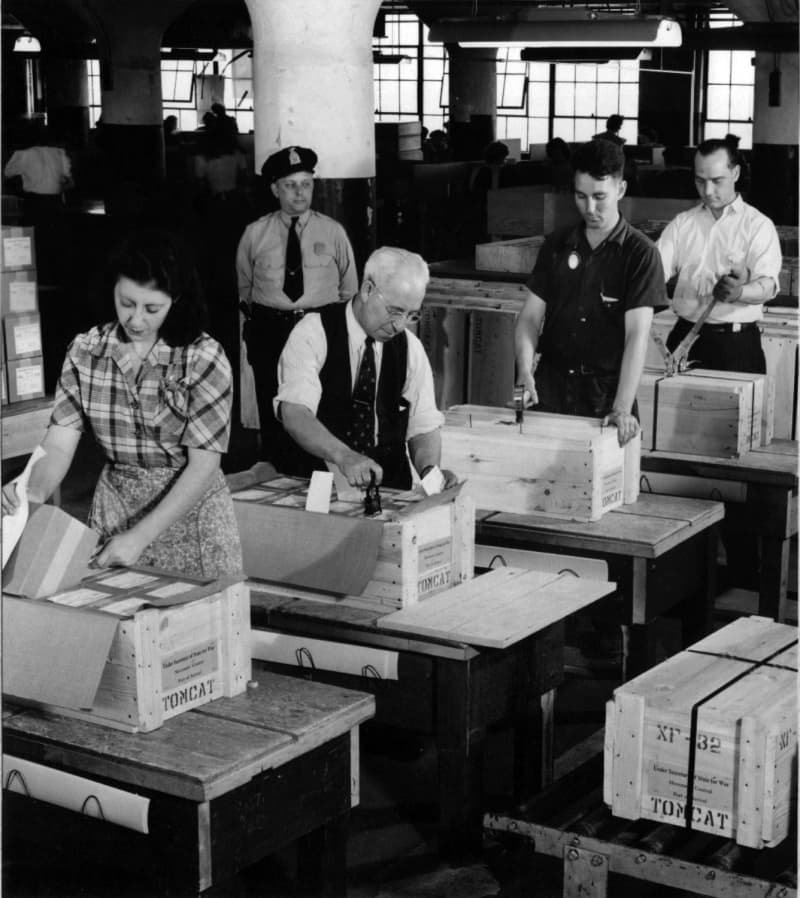
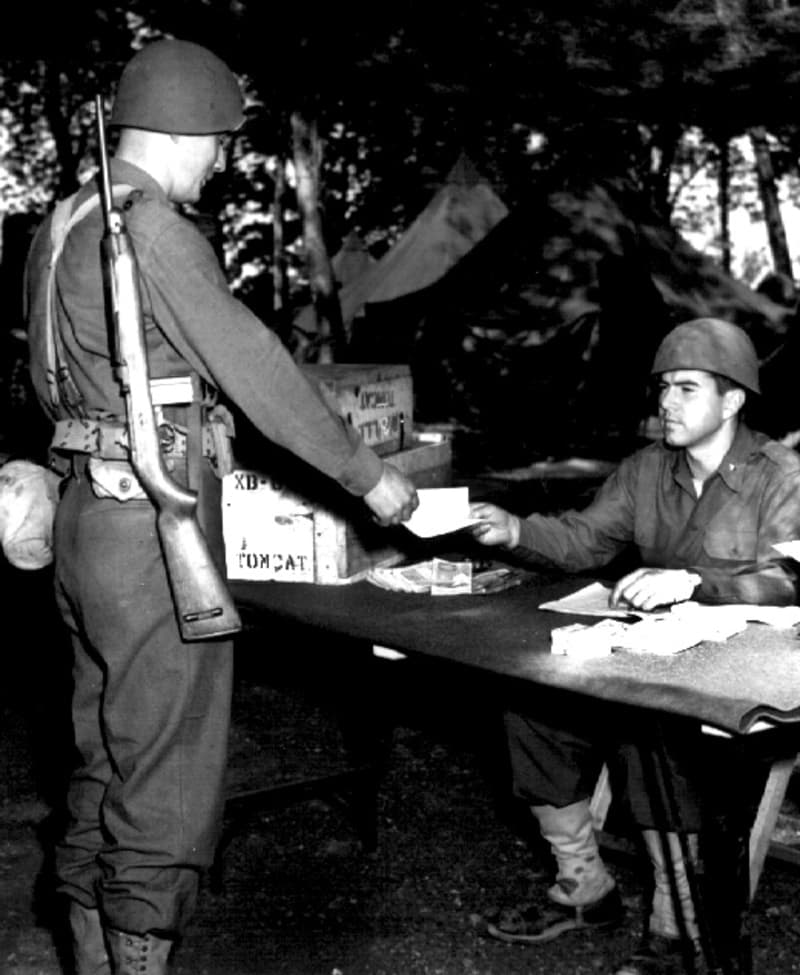
Operation Tom Cat notes being sealed in wooden boxes in Massachusetts above and one of the boxes on the pay table in England in June 1944 immediately above.
Do you have a favorite note, coin, bond, medal or token? Of course you do. It certainly gets harder to decide as the years---and decades---slide by and the purchases pile up. Furthermore, at least in my case, the favorite selection cannot change. For me at least, there is a tendency to hold in particularly high regard notes that I have been seeking (often chasing) for a long time. A concept related to favorite notes is most wanted note. That can be a subject for another time.
This report first appeared in 2013 in Paper Money magazine in a somewhat altered version. It also appeared in the Gram in 2021, 2022 and 2023 for the D-Day edition and likely will appear again in the Gram in 2025 and beyond.
I have some rare notes and even some really rare notes and I like them all. Some of them have been recognized as being rare over all the years that I have collected. A few were not recognized as such when I took them home. Of course there were some apparent rarities that I gleefully took home only to have them later slip to a more common rating.
A few of my rarities even were found in junk boxes! The bad news is that not a single one of these junk box rarities in my collection was found in the boxes by me! On more than one occasion an excited collector has shown me a note that he had plucked from a junk box then sold to me at a substantially higher price. In such cases I am not upset. I am happy! I like people to bring their finds to me. I would much rather have a great note at a high price than to not have it!
I have paid some high prices for notes. Really high. Mind numbingly high. Even marriage wrecking high. I am happy that I can say that I really like all of those high-priced notes, but I can assure you that price has little to do with love as you will see. I just must throw in that none of my favorites are prized because they are one of the finest examples or even the finest example known. I am much more likely to like a well-circulated note that is the only one known, but my favorite does not fall in that category either---far from it.
Having said all of this, I can (and will) tell you what my favorite note is, but first a few more twists. I owned one of these notes long before I recognized it as even a candidate for favorite. There is another significant problem with selecting the favorite note. I love all of my babies.
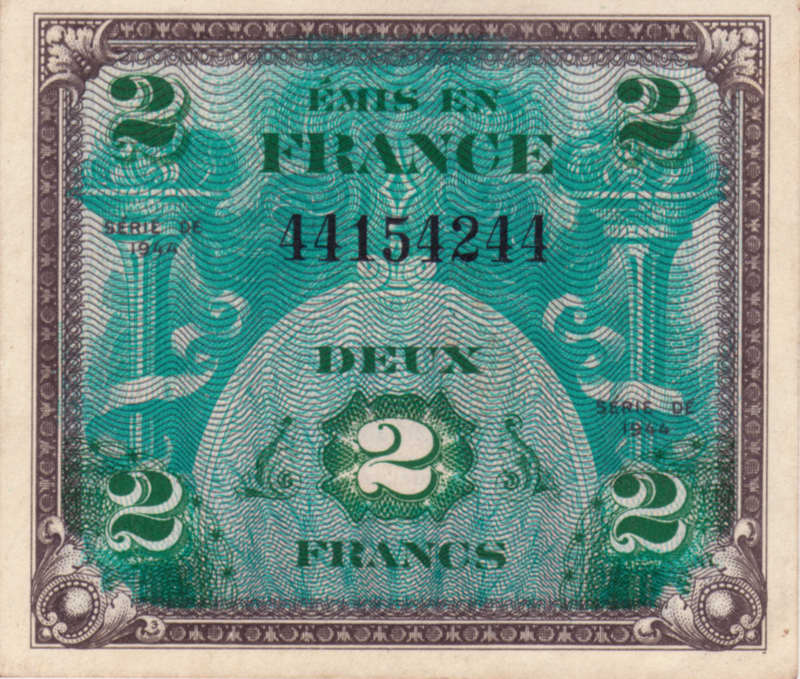
In spite of this, I can tell you that I believe that my favorite note is the ultimate of history in your hands. It is the extremely common Allied military 2 franc note!
This note was created in the United States on behalf of the Allies expressly for the invasion of France: D-Day, 6 June 1944. These notes were in the pockets of every soldier, sailor, airman, coast guardsman, and Marine who attacked the continent on that day. I cannot see a picture or movie about D-Day without thinking of those notes in the pockets.
Wonderfully, there is much lore to add to the history of those lowly 2 franc notes. First, let me explain why I like the 2 franc note the best when the series has notes as high as 5000 francs that are rare. It is the irony of it. That little 2 franc note is so small of size and denomination to be all but unnoticed by collectors today and even in commerce in 1944. Like the common fighting man it was there to do a job without any fanfare.
Furthermore, that small size and denomination made it an ideal souvenir for those fighters. At least many thousands of the 2 franc notes were put into envelopes and sent home to loved ones as souvenirs and symbols of where the sender had been and what he had done. Often, the sender wrote a few words on these notes: words of love, time or place. If those soldiers, sailors, and airmen, thought enough of those 2 franc notes to send them home, then we (at least I) should respect them (both the people and the notes).
The notes are not inexpensive, they are downright cheap. You can easily pick up some nice very fines at a show for $2 (a fitting price I must say) or less, often substantially less. I cannot stop myself. I have hundreds of them.
I try to always carry one of these notes on my person in the hope of striking up a conversation with friends and strangers. If the person seems truly interested, I present the note at the end of the conversation with the admonition that the note represents the unbelievable courage of all those thousands of men on D-Day and that the world (borrowing from Winston Churchill) will recognize that courage for a thousand years.
In addition to the emotional factors above, the Allied military franc notes are fascinating in many ways that are more commonly appreciated by collectors.
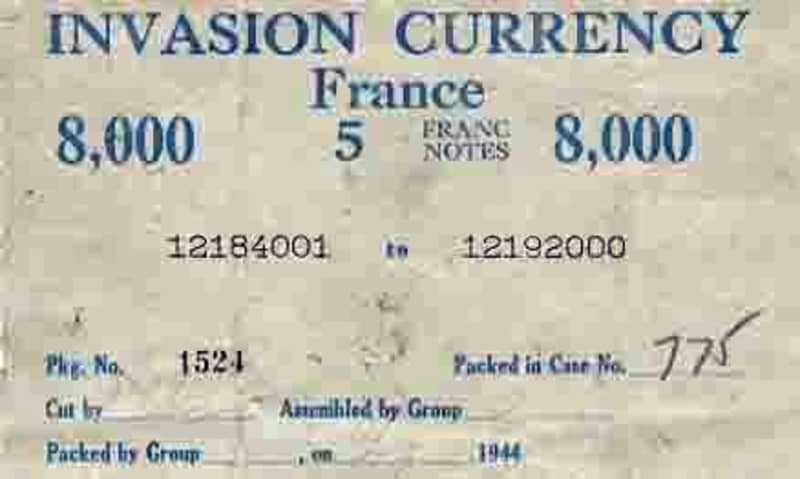
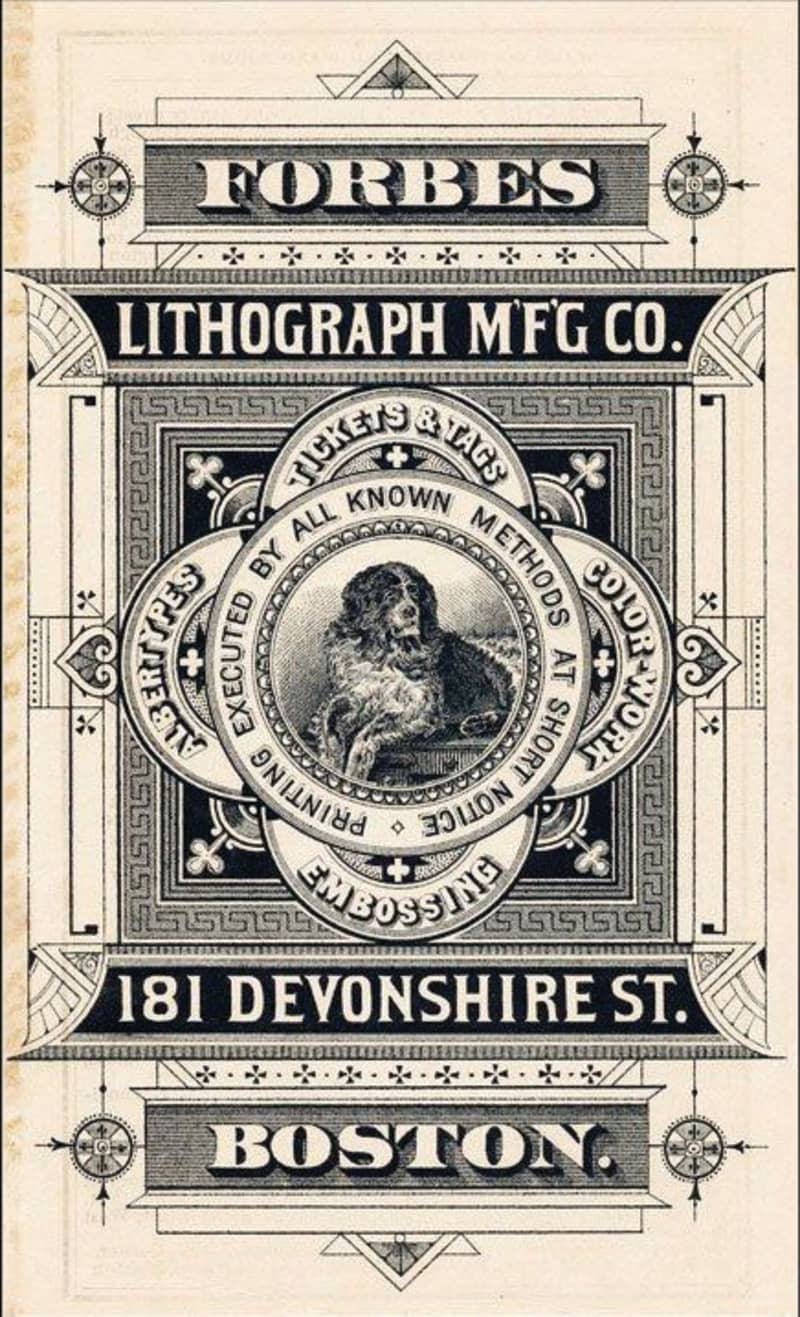
End label from the Niel Nielsen collection.
As I said, they were printed in the United States. Mostly they were printed by the Forbes Lithograph Manufacturing Corporation. The Forbes monogram F is included on all of the franc notes.
They were printed as Operation Tomcat. This is an intriguing bit of information. It is well-known that the D-Day operation itself was Operation Overlord. The purpose of code names is to allow discussion of details without violating security.
Collectors first learned of Operation Tomcat in 1968 in the seminal article by Neil Shafer and Ken Bressett. Since then we have found wonderful, amazing even, confirmation of that fact.
The photograph that Joe and I selected for the cover of World War II Remembered is of pay operations somewhere in England a few days before D-Day. A young lieutenant is paying the troops at a table under camouflage netting. The soldier being paid has an M-1 carbine and the officer has a pistol on the table.
If you look at the table carefully, you can see a nice stack of the square Allied military francs (2, 5, and 10 franc notes are all of the same small square shape and size). Very dramatically there is also a wooden shipping box on the table painted Operation Tomcat!
More subtly, Bank of France notes are also on the table. This confirms another important--if little appreciated--aspect of AM francs. It is common to call them invasion money, liberation notes, spearhead notes, and even occupation money. The French people sometimes called it American money. These various terms have differing degrees of credibility, but the notes were officially known as "supplemental francs."
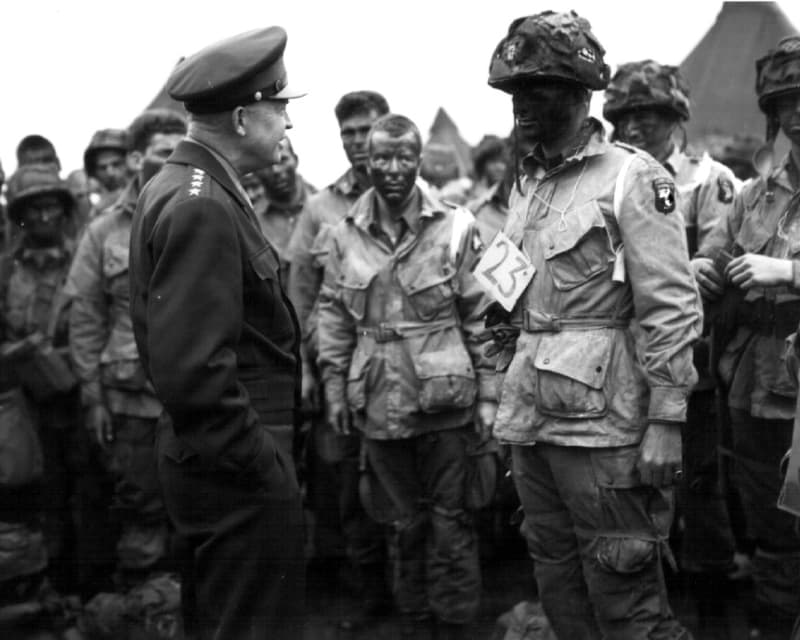
General Eisenhower chatting with airborne soldiers of the 101st Division on the eve of D-Day. If you look real, real close you can imagine seeing AM francs bulging in the pockets of the airborne soldiers!
This is an important point. When the issue was planned, printed, transported, and distributed, it was intended to supplement the Bank of France notes that the Allies expected to find in circulation. This intended use is demonstrated by the use of the AM and Bank of France francs on the pay table in the photograph. Importantly, the supplemental terminology can also be confirmed by its use on the covers of specimen books of the D-Day notes.
Of course at Forbes the notes were lithographed. The designs were simple. The notes were appropriately Series 1944. This fact is on the face of the notes but of little consequence in identifying the notes. They do not have a signature, but they are numbered and as usual the serial numbers are of great interest to us.
The numbers are really quite extraordinary. They are typical eight numerals but without prefix or suffix. Obviously, the numerical limit for such a system is 100 million notes (possibly by adding a replacement for the last note).
To number beyond the 100 million limit, the printers, Forbes and the BEP (on a small number of notes) added an additional number to the field of the notes; numeral 2 for the second block etc. It was necessary to number a second block for the 2, 5, and 100 franc notes. I especially like the extra "2" on the 2 franc notes!
In most, if not all, cases world-wide replacements are indicated by altering the blocks. Even though the blocks in this case consist of only one (or no) numeral the same system was used. For replacements, the block number is replaced by the letter "X."
Compared to Operation Overlord, Operation Tomcat was a relatively small undertaking. Of course Tomcat was important to military finance personnel, Forbes workers and management, and even important to BEP management. Surprisingly, this detail of Allied planning became the source of some international political turmoil.
In due course Allied staff officers visited General Charles de Gaulle at the Free French headquarters in London. The staffers showed the notes to the general who immediately rejected them as unsatisfactory! There were two major points of contention. The notes were not signed and had innocently applied but offending text: "Emis en France" [Issued in France]. The general pointed out that no one issues notes in France but Frenchmen and that this text indicated otherwise.
Furthermore, General de Gaulle said that if the Allied headquarters went ahead and issued these notes, that he, Charles de Gaulle, would announce via radio that the people should not accept the notes.
As you can imagine, the staff officers were stunned. What they viewed as a courtesy visit had turned into a potential disaster. They returned to SHAEF (Supreme Headquarter Allied Expeditionary Force) to report the problem to the supreme commander, General Eisenhower.
We have no information on this, but I would love to know what alternatives the staff guys thought up before they got to see Eisenhower. Did they consider scrapping the entire issue and printing a new one in England perhaps? How about overprinting the Tomcat notes? Perhaps they considered trying to get enough Bank of France notes. We likely will never know, but there is always a chance of a diary or other as yet unfound document will tell us.
Back a SHAEF, they asked Ike what they should do. After a pause, Ike responded that they should issue the notes. Somewhat taken aback, they asked under whose authority. He leaned forward (I cannot document the leaning part) and said "On my authority." As you can imagine, that was good enough for the staff officers.
Who decides if an issue of money is good? The chief executive? Financial authorities? Central banks? In this case the supreme commander? No. The people decide. The Allies went ashore on June 6, the people gladly accepted the money, and General de Gaulle kept quiet. However, it is very interesting that the German army saw the same flaws as de Gaulle and ran a propaganda campaign to discredit the notes.
Wow, what a story and it is only half of the tale! Additional accommodation was made to General de Gaulle. A series of notes was printed by Forbes that fixed some of the objections. Specifically, the offending terminology was replaced with the rather bland but safe word "FRANCE," but no signature was added. The back designs were changed completely with the French flag again replaced by the safe word "FRANCE."
Interestingly, the notes were officially called "Provisional Francs." That was because they were created on behalf of the provisional government of France. As far as I know, they were issued indiscriminately with the supplemental and Bank of France francs. It is also not known if there was some accounting magic done to charge the provisional government for manufacturing and shipping the notes.
The smallest three denominations were not printed for the provisional issue. The same numbering and replacement systems were used for the provisional as supplemental francs although ten blocks were necessary for the 100 franc notes!
Ten blocks means 1 billion notes! This is important because it means that we should expect the replacement for this issue to be the most abundant replacement in spite of its relatively high denomination. It is in fact the most common AM franc replacement.
I am not going to try to get into the small details, but there is an interesting variety in these 100 franc notes.
The block two notes were numbered at the BEP rather than at Forbes for uncertain reasons almost certainly regarding work capacity. The wonderful thing is that while the Bureau used the same numbering font, the block font is substantially smaller than the one used by Forbes. Furthermore, as you would then expect, the replacement "x" is also of the small font. While overall the provisional 100 franc replacement is common, the small x is a very rare replacement!
Just as with the supplemental issue the provisional issue included a 5000 franc note that was not generally issued. However, for less apparent reasons the provisional 500 franc notes were also not generally issued and are rare.
After all of this there is much more to learn about AM francs. Of course Joe has more and different info for you.
Forgive me if I have to tell you that the best source for additional information is World War II Remembered.
I actually believe that the Allied 2 franc note is the most common note in collections in the world! Of course it gets down to the definition of collection. You will find this note in every collection of French notes, World War II notes, notes printed in the United States, and most importantly in family collections of mementoes.
Special Serial Numbers Report 15
from Logan Talks
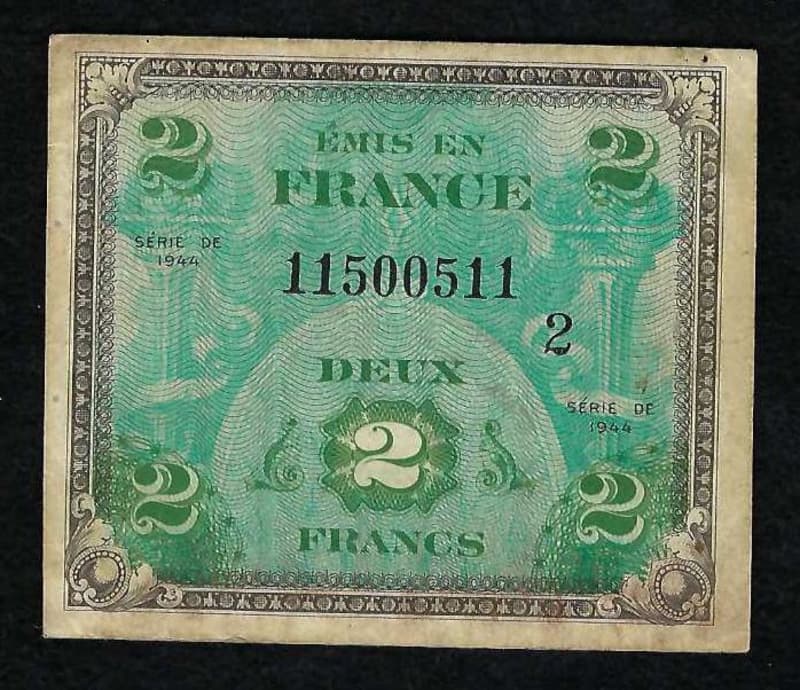
D-Day fancy serial number! Not only is it a D-Day note, but radar was invented in World War II!!
[This is the first special number provided by Logan Talks (just in time for D-Day). He is following the great reports by Doug Bell and Ed Beaman.--Editor
Editorial
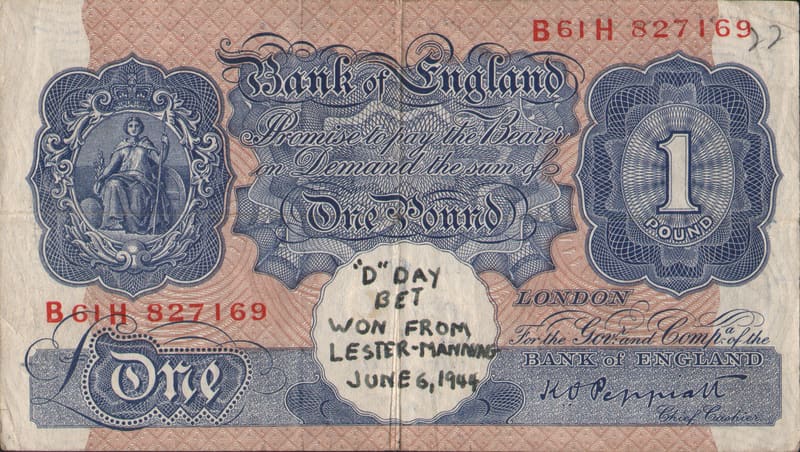
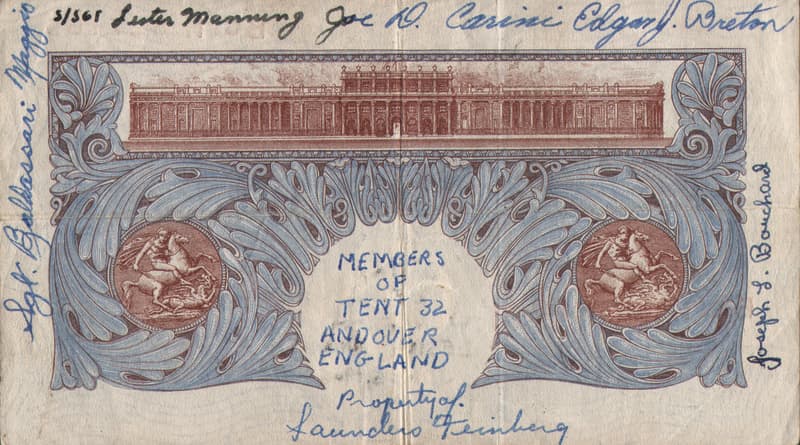
There are more D-Day items to collect than just Allied military currency. I am sure that I have not even thought of all of them. Here are two nice items. The first is a short snorter. There are many of these. I do not have a lot of them, but I like them all. This one is particularly cute. It paid of a "tent pool" so to speak on when D-Day took place. I particularly like that the location of the staging area is given. Hanover tent 32! How cool is that! It likely is possible to find out more about the Hanover staging area.
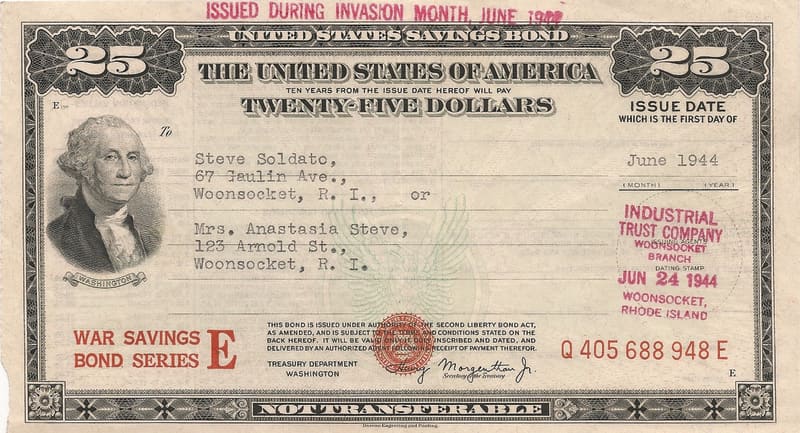
The war bond above is another D-Day item. It was issued in what the Treasury Department called invasion month. Treasury also specifically authorized marking the bonds sold in June as being "issued during invasion month." These bonds are little known by must collectors which is offset by their scarcity and desirability.
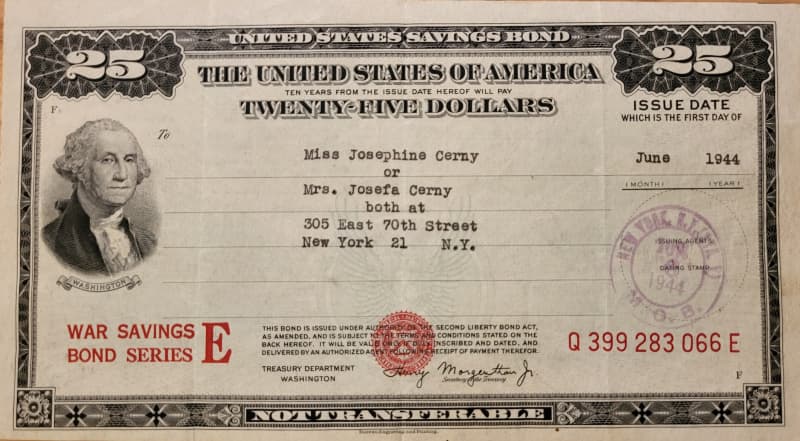
The invasion month bond above is as opposed to the bond immediately above that was purchased on D-Day. This image was provided by Jim Downey.
Commemorative Coins and Medals
by Bill Myers
D-Day is a very common subject for coins and medals. Most are inexpensive but there are some gold issues that are of course more expensive and even some of the inexpensive items can be difficult to locate. We are pleased to add D-Day coins as a feature of the Gram D-Day issue.
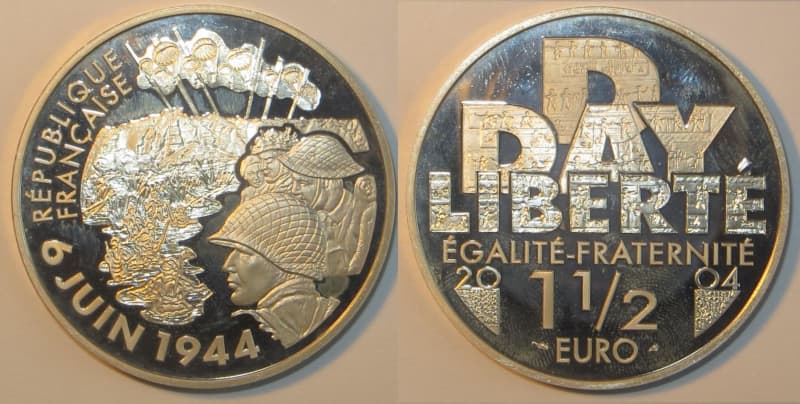
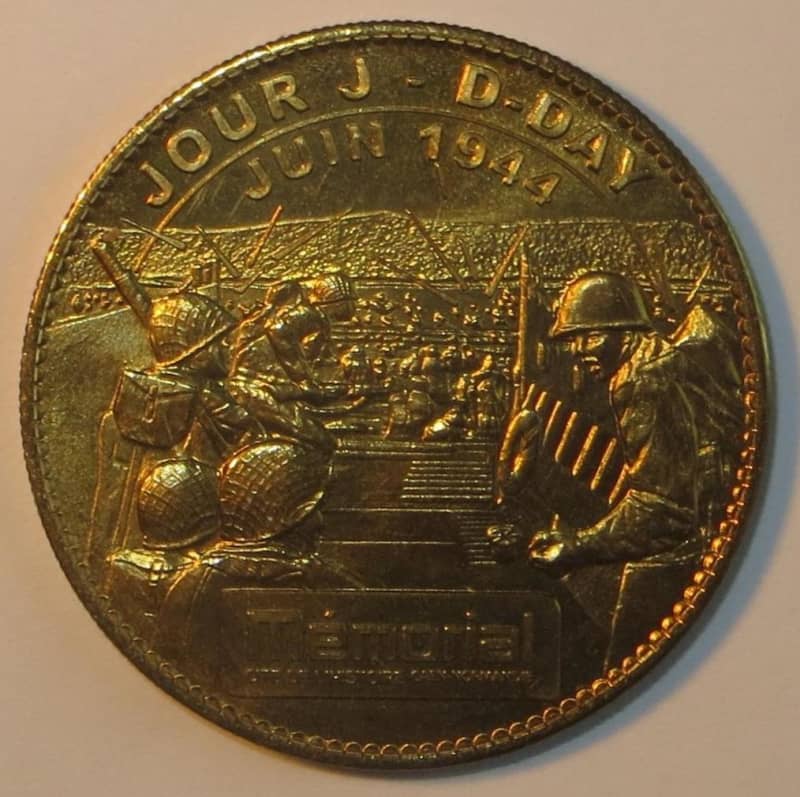
French D-Day museum medal
[to be continued]
Editorial
My favorite Gram is this one--D-Day. It is my favorite because the military operation known by the media as D-Day, but more correctly called Operation Overlord is one of my favorite subjects for study and, of course, it is full of numismatic aspects. What could be better?
Of course there are always problems. Bill Myers sent a group of images as you can see from the samples above. He even sent them in a timely fashion. However, I have had difficulty downloading them. I have a work around, but I was not able to finish the task in time for this issue.
My usual approach in such situations is to label problems as features and move onward. In this case that means that we will continue Myers' coin feature in the next Gram. Furthermore, we might make the D-Day Gram a two issue feature henceforth! That means that you can send in even more D-Day items!
Mail Call
The MPCGram welcomes letters from readers. Letters should be relevant to military numismatics. Letters may be edited. Senders must be known to the Gram and names (actual or "Internet") will be used.
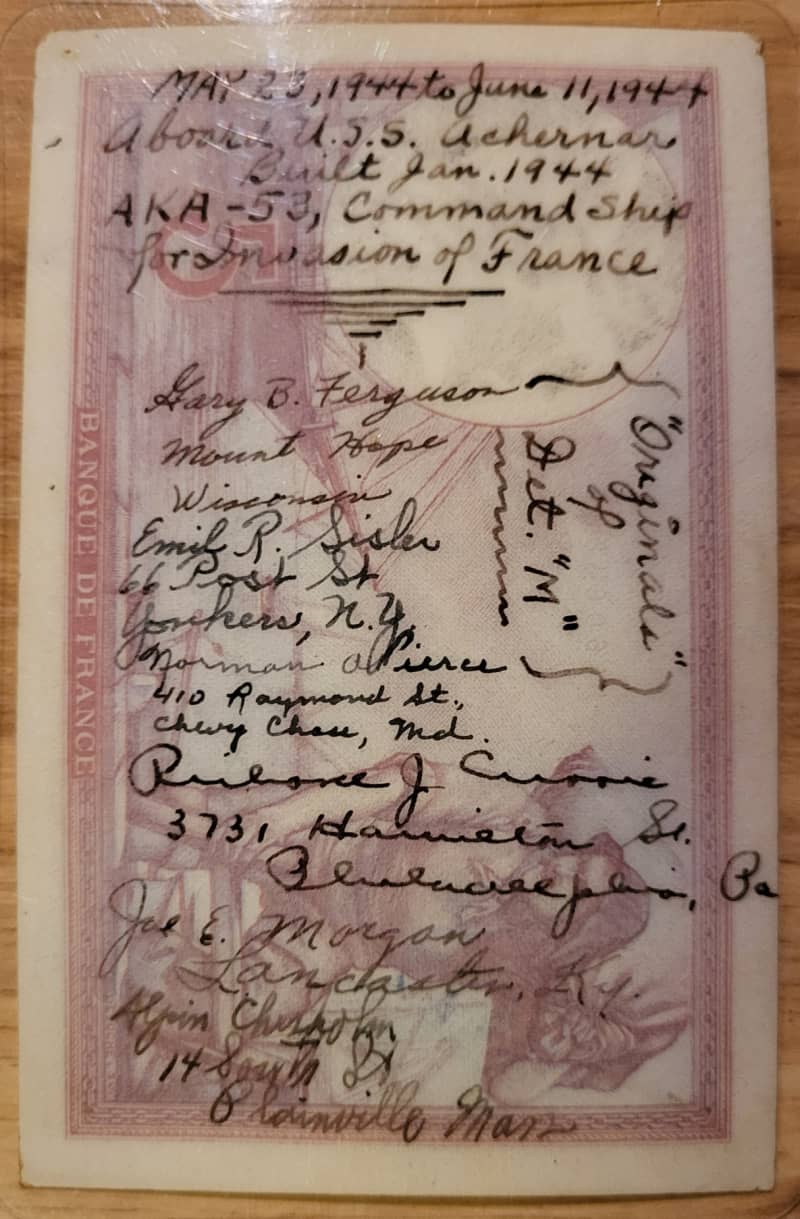
Here is a short snorter signed by men who were part of a detachment on the command ship. I thought that you might like it for the D-Day Gram.
— Jim Downey
Dear Jim, Wow. Thank you!
Editor
Training Schedule (Calendar)
2023
In this section, the MPCGram lists events that are likely to be of special interest to collectors who are interested in MPC and other type of military numismatic items. We do not list "routine" coin shows where a collector might find a few items by chance. However, if we know that some Festers or Gramsters will be there we will list that same show in the hope of promoting fellowship. Send us your reports.
2023 shows/events
- MSNS 23-25 June (conflicts with week 2 of summer seminar) several Festers attending
- ANA summer seminar - 17-29 June
- ANA World's Fair of Money(R) 8-12 August, Pittsburgh Festers attending, Boling to be installed in ANA HOF
- MSNS 17-19 Nov Festers attending
2024 shows
- ANA National Money Show(R) - 14-16 March, Colorado Springs
- Religious holidays (Easter +) -- March 24-31
- MPCFest 25 April 12-14
- MSNS -- April 19-21 -- Warren, MI Festers attending
- Georgia Numismatic Show -- Apr. 19-21 Festers attending
- CSNS -- Apr. 29-May 6 -- Schaumberg, IL Festers attending
- Maastricht -- May 3-5 Festers attending
- ANA World's Fair of Money(R) - 6-10 Aug, Rosemont
2025
- ANA World's Fair of Money(R) - 19-23 Aug, Oklahoma City
Please help us fill in the dates for events listed and give us any additional events that might conflict. Thank you very much.
Resources
MPC Boot Camp by Fred Schwan https://youtu.be/ReL-dBk2cPk
MPCFest Sponsors
Joe and Louise Boling, Steve and Ray Feller, Dave Frank, Al Glaser, Dave Hunsicker, Brett Irick, Harold Kroll, Mike Marcil, Bill Myers and Warner Talso.
MPCFest is possible because of the generous support of its sponsors.
Gram Exchange
FOR SALE
Send your text and images (!) to the editor for inclusion in the Gram Exchange. Please send the images in jpeg format with each image in a separate file.
List your items for sale here for FREE.
New, fifth edition of the standard MPC reference book the Comprehensive Catalog of Military Payment Certificates by Schwan and Smulczenski. Now full color and packed with great information. $75 postpaid. No waiting--the fastest service possible. Send your snail mail address via email and we will send your book with an invoice. The digital version of Comprehensive Catalog of Military Payment Certificates after some delay is now shipping at $40. Send to fredschwan@yahoo.com.
WANTED
Wanted to Buy [WTB] / In Search of [ISO] $10 Series 1934A North Africa silver certificate with the altered blue seal discussed in October 2022 MPCGram by Larry Smulczenski (Saturski #13) and covered in May/June 2008 SPMC article written by Peter Huntoon and Jim Downey. Please contact Andy Conroy (andyqconroy@gmail.com).
MPC Gram Staff & Info
- Publisher and editor: Fred Schwan fredschwan@yahoo.com
- Editor emeritus and columnist: Roger Urce stjasele@gmail.com
- Financing the war columnist: Warner Talso - wwtalso@gmail.com
- Columnist at large: Bill Myers
- Columnist at large: Jim Downey - mufelika@charter.net
- Columnist: Fabrizio Raponi runfab@gmail.com
- Columnist: Louise Boling copperboling@gmail.com
- Fest auctioneer: Dave Frank - dave@frankcomputers.com
- Fest yearbook editor and photographers: Kris and Cuneyd Tolek - ctolek@yahoo.com
MPC Gram is published by BNR Press as a free service to the community of military money collectors. Your suggestions, criticisms, complaints, editorial contributions, letters, and even praise are very welcome. The entire contents including linked illustrations are copyright protected by the publisher. In the case of contributors, the copyright is protected on behalf of the creators.